
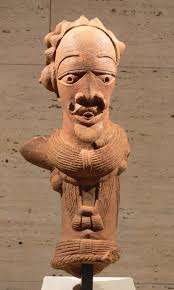


Before Christianity and colonialism, the people of present-day Nigeria practiced different art forms that portrayed their cultures and religions. These art forms included the Nok Terracotta Figures, the Ife Bronze Heads, the Benin Bronzes, and the Igbo-Ukwu artifacts. Over 2,500 years ago, there was a civilization that in itself had its peculiar art forms and culture, much older than the origins of Christianity. This was the Nok Terracotta of the Nok Culture, which, upon radiocarbon tests, dated to 500 BCE.

The Nok people were one of the earliest societies that existed in present-day Nigeria in West Africa, from 500 BCE to 200 CE. As such, their sculptures have been linked to being the oldest art forms in West Africa. There is no proven geographical evidence of where the population of the Nok culture may have dwelled, but archaeological findings discovered large deposits of the Nok Terracotta near the Ham village of Nok in southern Kaduna State, Nigeria. This was how the name ‘Nok Terracotta’ came to be. While much of their history is unknown, they were most likely farmers who used tin ore and clay in their locations to create art forms representing their culture.

Map showing excavation sites of the Nok art
The first Nok terracotta was discovered accidentally in 1928 at a level of 24 feet from a tin mine, near the Nok village, by Colonel Dent Young, who co-owned a mining partnership. Young presented these findings to the Museum of the Department of Mines. 15 years later, in 1943, a clerk in charge of a mine at Jem discovered new deposits of clay figurines, including a terracotta head, during a tin mining operation. It was Benard Fagg, an administrative officer and archaeologist, who observed the similarities between the terracotta head of 1943 and that of 1928.
The term ‘terracotta’ means coarse and burnt clay. The Nok arts were made from terracotta, which was first coarse and porous clay, then it was sculpted and fired until hard. There were three periods of artistic development in Nok arts: the prehistoric period, the middle stylistic period, and the late stylistic period. Each period had a distinct approach to art creations, but it also had similar features to the preceding periods.
Terracotta was the major approach in prehistoric times, where figurines molded from porous and coarse clay were sun-dried and then baked in a primitive oven at about 100 degrees Celsius. This gave them a brownish-orange color. After firing and glazing, the figurines would be fire-resistant.

In the middle stylistic period, art forms were discovered in more sites, dated from 900 BCE to 4000 BCE. This was proposed by archaeologists as the high point of the Nok culture. The art forms had decorations reduced to thin bands up to 5 cm in width.
Though findings in the late stylistic period, dating 400 BCE-300 BCE, were quite different from other periods, relevant to the migration of the Nok people from hills to valleys due to climate change, the artworks retained the notable features of Nok Terracotta.
There were stylistic similarities in the Nok’s depiction of people and animals in their art forms. These included the use of triangles, circles, and semicircles to portray facial features; hair parted into mounds; triangular eyes with holes; and a large hole for a mouth.

While the Nok people were mostly potters, their iron-smelting technology contributed to their great terracotta works. Archaeological findings have produced scattered evidence of wrought iron production in Nok culture and art. The excavation sites produced iron furnaces, terracotta figurines, stone axes, stone tools, stone balls, and clay artifacts.
.
Click here to learn about the ironworking of the Nok culture.
Quiz
- Where and when was Nok Terracotta first discovered?
- How many periods of approaches were seen in the Nok arts?
- Why is it called "terracotta"?
- Why is it called Nok art?
- What other handicrafts did the Nok people practice?
- What are three objects found in the excavation sites?
- What are the distinct features in all three periods?
- Who discovered Nok terracotta in 1948?
- Where did Young take his discoveries?
- Archaeological findings date the Nok Terracotta to which year?
Photo credit:
Museum of the Department of Mines
Wikipedia
References:
Wikipedia
Researchgate
National Geographic Society
Britannica
Archaeology Magazine