
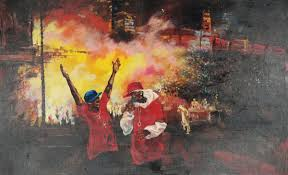


Art has long served as more than a means for showcasing beauty or decoration. Since history, it has also been a language of resistance, a mirror of society, and a tool for activism. Chinụa Achebe (1930-2013), in his essay titled “Africa and Her Writers,” writes that “there is no rigid barrier between makers of culture and its consumers. Art belongs to all and is a “function” of society.” In the Nigerian society, where there is the existence of several national problems, artists have often used their creativity to inspire dialogue, challenge oppression, and imagine alternative futures. One of the most popular artists in this long tradition is Lemi Ghariokwu, whose colorful and bold visual works have become symbols of resilience, freedom, and social consciousness. Exploring Ghariokwu’s art within the context of Nigeria’s post-independence era reveals how aesthetics can be used to wield activism, inspire hope, and negotiate conversations about justice, freedom, and equality.
The concept of art as activism borrows from the idea that art can manifest beyond aesthetics to engage directly with political and social realities. In Nigeria, this tradition is deeply rooted. During the colonial times, artists and writers used their craft to critique imperialism and to reaffirm African identity. The works of writers like Chinua Achebe and visual artists such as Ben Enwonwu are notable examples of this intellectual resistance. After independence in 1960, Nigeria’s optimism was quickly challenged by political instability, military coups, civil war, and persistent corruption. These challenges created fertile ground for artists to transform their work into acts of defiance and consciousness-raising.
Artistic activism in Nigeria has taken many forms—from literature, poetry, and music to painting, sculpture, and performance. What unites these diverse practices is a shared commitment to truth-telling and inspiring collective action. This is the context in which Lemi Ghariokwu’s visual art emerges as particularly powerful.
Ghariokwu, often called the “rebel with a cause,” rose to prominence in the 1970s and 1980s through his collaborations with Afrobeat legend Fela Anikulapo-Kuti. His album cover designs for Fela became not only iconic but also deeply political, capturing the essence of Afrobeat as music of resistance.
Ghariokwu was born in Lagos in 1955. He grew up witnessing the turbulence of Nigeria’s early years of independence, marked by coups and authoritarian rule. He found in art a means of expression that combined satire, symbolism, and vibrant imagery. Unlike artists who sought to separate aesthetics from politics, Ghariokwu embraced the fusion of both. His visual language—bold colors, exaggerated forms, and collage-like compositions—became a canvas for critiquing authoritarianism, social injustice, and the contradictions of modern Nigerian life.
By focusing on everyday struggles and weaving them into striking visuals, Ghariokwu ensured that his art was accessible to a wide audience. His works were not meant only for galleries or elite spaces; they adorned record covers, posters, and walls, circulating among ordinary Nigerians who could identify with the messages embedded in them.
One of Ghariokwu’s most notable contributions to Nigerian art is his ability to tackle social and political themes with optimism and vibrancy rather than despair. Much of Ghariokwu’s art reflects a defiance of military dictatorships and corrupt elites. By illustrating Fela Kuti’s critiques of government and foreign exploitation, his album covers became visual manifestos against oppression. Works such as Authority Stealing (for Fela’s album of the same title) visually captured the hypocrisy and corruption of Nigeria’s ruling class, making abstract critiques tangible.
His art emphasized African identity and motifs, which was itself a political act, resisting cultural erasure and affirming pride in being African. His bold representations of Black figures countered colonial stereotypes and empowered audiences to embrace their heritage.
While his works often critiqued injustice, they also held space for imagining freedom. His aesthetics—bright colors, dynamic figures, and exaggerated features—conveyed vitality and resilience, symbolizing hope even in moments of turmoil. This ability to balance critique with optimism helped foster dialogue rather than despair.
Ghariokwu frequently drew inspiration from the streets, capturing the vibrancy, humor, and struggles of ordinary Nigerians. In doing so, he bridged the gap between art and daily experience, ensuring his work resonated widely.
One of the unique aspects of his activism lies in his use of bold aesthetics. While activism is often associated with protest marches and speeches, Ghariokwu demonstrated that the visual appeal of art itself can be a form of resistance. His striking colors and playful yet critical imagery drew people in, making them curious, engaged, and thoughtful.
By embedding powerful political messages within accessible and vibrant artwork, he disrupted the notion that activism had to be confrontational in traditional ways. His art made resistance beautiful, memorable, and impossible to ignore. In this way, aesthetics became not just a backdrop but an integral part of activism.
Artists like Ghariokwu function as chroniclers of history in Nigeria’s post-independence era. They served as watchdogs of power and visionaries of better futures. Where politicians failed to deliver justice, artists provided spaces for reflection and dialogue. Ghariokwu’s art, for example, challenged Nigerians to question authority, recognize their dignity, and believe in the possibility of freedom. By circulating widely through music and popular culture, his works reached beyond elite circles and touched the lives of everyday people.
Till today, Lemi Ghariokwu maintains a highly reputable legacy and contemporary relevance. His works have been exhibited internationally, and his style has inspired younger generations of African artists who see creativity as a tool for change. In contemporary Nigeria, where issues like police brutality (highlighted by the EndSARS movement), inequality, and corruption remain pressing, his art reminds us of the enduring power of visual activism and challenges contemporary artists to consider how their work can move beyond self-expression to serve as instruments of justice. In an age where digital platforms allow art to spread rapidly, the model of activism embodied by Ghariokwu feels more relevant than ever.
REFERENCES
- Chinua Achebe on Art as a Form of Citizenship: Lessons in Creativity as “Collective Communal Enterprise” from the Igbo Tradition of Mbari. The Marginalian. https://www.themarginalian.org/2020/08/06/chinua-achebe-mbari/
- Lemi Ghariokwu. Biography. https://en.wikipedia.org/wiki/Lemi_Ghariokwu