
Passenger(s)
It greeted me as I returned after two years away, as our rusty bus, worn out by its long, unresting journey from Lagos, made it to the main park. We were greeted by the chaos, by the multitude of infinitesimal habitats wielding a shape that synced to the urban rhythms of the open park. It greeted me as the witty-captioned billboards in the open scenery where slangs were stylized to capture local attention. A particular one reaching for the sky and serving as a sitting place for a group of swans heralded the words—OTF—which advertised for a popular men's clothing company. OTF is short for Only The Family. It is a popular slang among the thuggish boys who hold a distinction as low-budget musketeers in this rogue city. Its usage alternates as an entrepreneurial gimmick targeted at swallowing the expenditures of the thugs, as they would always love to wear something symbolic of their creed.
It greeted me as the passionate vista of a uniformed group of beggars as they passed by the bus stop, singing in high-pitched voices like one acapella of broken angels. They wore tattered, crisp clothes, and looking at the dryness of their feet, one must agree that they had walked a long, arduous journey. They were led by a worn-out boy who steered the stick that they all held on to. Some of the passengers from my bus, as we alighted, were moved to pinch rumpled naira notes into the boy's hand. But for me, a photographer taking more shots with the eyes than with a camera lens, it was just another spectacle unwinding its nostalgic feelers.
As I waited for a Molué headed for where I lived to come by, my sight continued to graze across the park, across the ocean of heads and vehicles flickering past with dusty hurry. There were so many things to hear that one could hear nothing at all. The voices of hawkers elevated the chatter of Keke drivers yelling the location they were headed to, adding prominence to this choir of noise pollution. And a muezzin hanging from the rooftop of the mosque stood distinct in its call for prayer. A group of Egrets circled around its dome, bringing back to me an unfamiliar scape of Kano—that holy city I have come to love for its eccentric noise and earthen landscape.
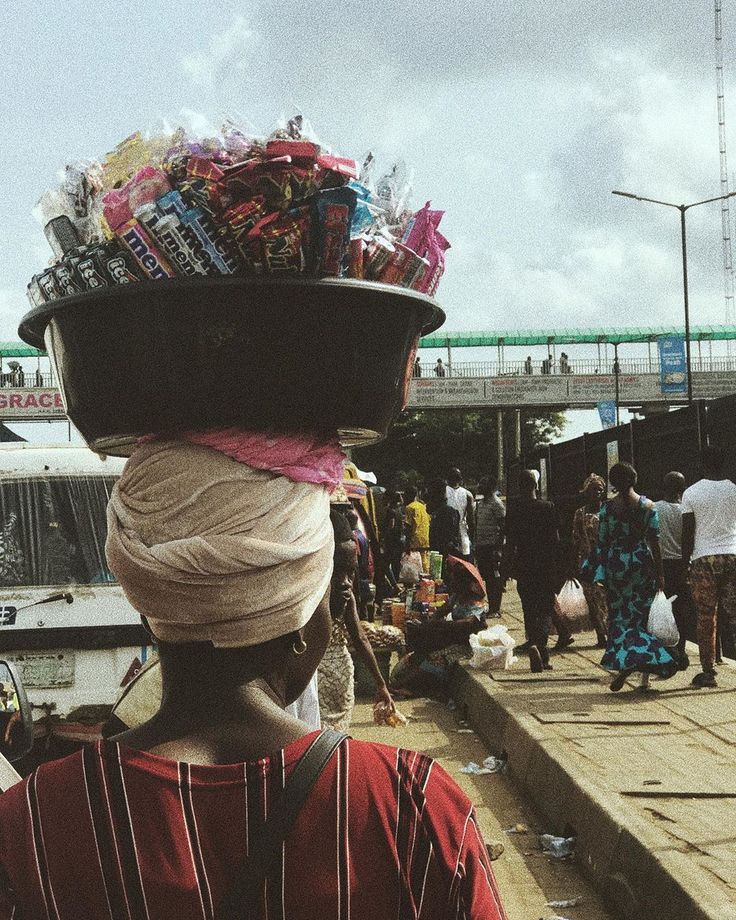
A Molué finally came across, and I struggled to enter as other people had also been waiting for one going to the same location as I. A mob of eager passengers began pushing through the entrance, and once, a dwarf made to enter, but his spindly legs and subdued proximity to the stair made him unable. Someone helped him in, while others looked bemused with a hint of suppressed laughter. I managed to squash myself into the last seat. I sat beside an old man on the right and an agogoro, or dry gin seller, on the left. She was a young lady clad in an orange hijab. A single dot of nose piercing added radiance to the dullness of her tanned face. Her basket of gin sat on her legs, and the sides grazed me. She looked at me pleadingly, and I returned with a smile. One thing about being in Aba is that one will virtually shapeshift to accommodate any condition. I could be no different.
In transit, our driver turned the bus stereo up loud, which was initially humming a Christian song. The sound filled the bus, along with the smell of stacked, sweating bodies. I heard the dry gin seller beside me hiss in continuity. Being close to her, noticing the subtle facade of nausea that graced her face, I discerned that the song must have made her uneasy, as she must be a Muslim. She probably could do nothing, as the only language most drivers understood was that of directions. She brought out her button phone and began playing a Muslim song. Hers was not loud, but it was loud enough to add a divergent inflection to the cacophony of the Molué, and of course, to pacify herself. And I hadn't thought much of it until another man two seats away from us began playing a fetish, traditional song by the Igbo maverick, Victor Uwaifo. His head was rumpled, as the flaps folded in thick manifolds separated by strands of hair. I thought I was the only one keen enough to have noticed the subtle clash on the bus, but just then, someone began laughing, and soon, others joined. Yet, the occasion was not resisted. Ever so continuously as we raced through the urbanesque roads, three different songs, being sung in three different languages, each meaning separate things, ricocheted around the carapaces of the bus.
“No gree for anybody oh for this country,” someone said, laughing.
As our Molué got to a go-slow situation somewhere along the cathedral, the view I saw was that of the Hausa men who sold shoes cobbled into roadside aesthetics. The men sat on a patio below their displayed shoes, their faces thrown in a fierce gaze against the reception of passers-by. Its appellation reminded me of the belief we held of these Hausa men when I was still a child running through our sandy streets. It was a conspiracy theory, morphed as chattery gossip, that the shoes they sold were part of the goods of Igbo businessmen confiscated by maritime personnel at the ports, which were later sold at auction to the Hausa men in order to minimize the crushing load of the country's hardship on them. This belief is still strongly held by many people in the southern region, and even now, I believe that some children still uphold it as street folk and must look at the Hausa men with some kind of resentment. I’ve been through it and gone as a traveler to understand that more ethnic sentiment anchored this belief than its validity. And I knew that the shoes were the grades sold as condemned in marketplaces, except the men had the good graces to remodel them with sparkling finesse.
Our Molué finally made headway through the go-slow after the driver had steered snake-like through the congestion and a frail policeman had battered glass windows with his club. He waved at our driver as he drove through with familiar passion.
When it was time to alight along the Obohia bus stop, I waited by the sidewalk after paying the driver and watched for a while as the other passengers did the same. Someone else helped the dwarf down, and I wondered why I was always an escapist of the most sensible of things to do.
The Molué was painted green, with a single stripe of white around it. It, in itself, was a nationalistic emblem that occurred to me as a moving metaphor for our Nigerian situation. I thought of the driver and his Christian song, of the Muslim lady, and of the problematic man who was bent on adding a poetic depth to the situation. In another dimension, I may have offered to tell the driver to mute his stereo in consideration of the diversity of his passengers. But I was unwilling to do this. And as I finally took a walk down the path that led to my street, as my quiet world of rumination offered homely rest in the familiar sight of the house I lived in, I decided to consider the latest event as just another spectacle, because certainly, my city was full of them.